Dedenne ex Emolga Deck Guide
 Lightning
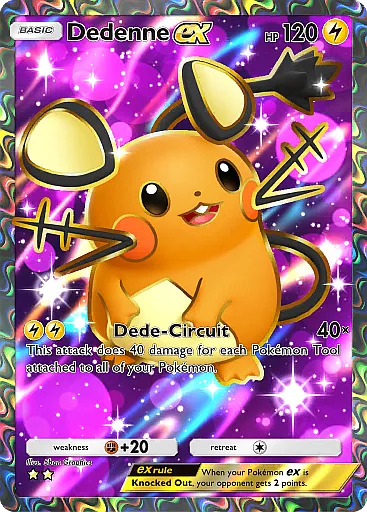
Dedenne ex Emolga is a Lightning toolbox deck that turns Pokémon Tools into direct damage. Both Dedenne ex and Emolga scale their attacks based on the number of Pokémon Tools attached to your board, while Pichu supplies Energy, Oricorio protects against Pokémon ex, and a flexible Tool package improves damage, survivability, mobility, and disruption.
Deck List
Pokémon (2)
Pichu
Oricorio
Trainers (18)
Dedenne ex
Emolga
Professor’s Research
Copycat
Cyrus
Pokémon Center Lady
Poké Ball
Giant Cape
Small Balloon
Electrical Cord
Lucky Egg
Protective Poncho
Field Blower
Energy
Source decklists
Source decklists referenced for this guide:
Strengths
- Dedenne ex can deal up to 160 damage with four Pokémon Tools attached.
- Emolga provides a one-point attacker that uses the same Tool-based damage engine.
- Pichu accelerates Lightning Energy to Benched Basic Pokémon.
- Oricorio can wall opposing Pokémon ex attackers.
- Every Tool improves damage while also providing practical utility.
- Giant Cape and Starting Plains improve the durability of the full Basic Pokémon board.
- Small Balloon gives strong mobility options.
- Electrical Cord can preserve Energy after a knockout.
- Protective Poncho protects important Benched Pokémon from damage.
- The deck can adapt between aggressive Dedenne ex turns and safer Emolga prize trades.
Weaknesses
- Dedenne ex only has 120 HP before HP modifiers.
- The deck depends heavily on Tools to reach its highest damage.
- Tool removal can reduce both Dedenne ex and Emolga damage.
- Pichu has low HP and can be knocked out before accelerating Energy.
- Starting Plains also gives the opponent’s Basic Pokémon more HP.
- Oricorio is much weaker against non-ex attackers.
- The deck can struggle if Dedenne ex is forced active before enough Tools are attached.
- Poor Tool placement can leave your Energy, retreat options, or key attackers vulnerable.
Strategy Overview
Dedenne ex Emolga is a unique Lightning deck built around one simple idea: every Pokémon Tool on your field makes your attackers stronger. The deck plays two different Tool-based attackers. Dedenne ex is the high-damage option, dealing 40 damage for every Pokémon Tool attached to one of your Pokémon. Emolga is the lower-risk non-ex attacker, dealing 30 damage for every Tool attached to your board. Since you can have up to four Pokémon in play, the deck can reach four attached Tools and turn Dedenne ex into a 160-damage attacker or Emolga into a 120-damage attacker. This makes every Tool in the deck do two jobs at once. Giant Cape adds HP, Small Balloon improves retreat options, Lucky Egg creates card advantage when a Pokémon is knocked out, Electrical Cord preserves Energy after a knockout, and Protective Poncho protects a Benched Pokémon from damage. At the same time, every one of those Tools also raises the damage of Dedenne ex and Emolga. The core challenge is deciding where to attach each Tool. It is not always correct to place every Tool onto Dedenne ex. Sometimes the best play is to put Giant Cape on Dedenne ex, Small Balloon on Oricorio, Electrical Cord on a Pokémon that may be knocked out, and Protective Poncho on a Benched attacker. The Tools still count for your damage total even when they are spread across the board. This version uses Pichu as the Energy accelerator. Pichu’s Crackly Toss allows you to take a Lightning Energy from the Energy Zone and attach it to one of your Benched Basic Pokémon. That is extremely important because Dedenne ex needs multiple Energy before it can attack, while Emolga also needs a proper Energy setup to become a reliable secondary attacker. The deck also plays Oricorio, which is one of the strongest defensive support cards against Pokémon ex decks. Oricorio’s Safeguard Ability prevents all damage done to it by attacks from opposing Pokémon ex. Against a deck that relies almost entirely on ex attackers, Oricorio can become a wall that buys you time to build Tools, attach Energy, and prepare Dedenne ex. Oricorio’s Safeguard effect is especially valuable because it can force opponents to find a non-ex attacker, use switching effects, or change their entire game plan. Dedenne ex Emolga is not a deck that wins by blindly filling the board with Tools. It wins by using Tools intelligently. You need to understand which Pokémon must survive, which Pokémon can absorb a knockout, when to use Pichu for Energy acceleration, and when to use Emolga instead of exposing a two-point Dedenne ex. The deck is especially interesting because it has both a high ceiling and a strong resource-management element. Dedenne ex can reach enormous damage, but it only has 120 HP before modifiers. Emolga deals less damage, but it only gives up one point when knocked out. Oricorio can completely shut down some ex-focused attackers. Pichu can provide a fast Energy start. Your Trainer and Tool package determines how effectively those Pokémon work together. Key Cards Dedenne ex Dedenne ex is the central damage engine of the deck. Its attack, Dede-Circuit, deals 40 damage for every Pokémon Tool attached to one of your Pokémon. The attack becomes stronger as your board becomes more equipped, so your main goal is to establish three or four Tools before relying on Dedenne ex as your main attacker. At four Tools, Dedenne ex reaches 160 damage. That is enough to threaten almost every relevant target in the format, especially when the opponent has already taken chip damage or cannot increase their HP. The weakness is Dedenne ex’s 120 HP. It is a two-point Pokémon that can be knocked out quickly if it enters the Active Spot without protection. Giant Cape and Starting Plains are both important because they improve its survivability and can force opponents to miss key knockout thresholds. Emolga Emolga is the deck’s secondary attacker and its safer prize-trade option. Windup Thunder deals 30 damage for every Pokémon Tool attached to your Pokémon. Its maximum damage is lower than Dedenne ex, but it gives up only one point when knocked out. That makes Emolga very useful in games where exposing Dedenne ex would be too risky. Emolga is especially strong when you already have several Tools in play but do not need 160 damage immediately. With three Tools attached across your board, Emolga deals 90 damage. That can be enough to remove smaller Pokémon, finish damaged attackers, or pressure an opponent while preserving Dedenne ex for later. Because both Dedenne ex and Emolga scale from the same Tool count, you can switch between them without changing your core game plan. Pichu Pichu is the Energy acceleration card that gives the deck a faster start. Crackly Toss lets you take a Lightning Energy from the Energy Zone and attach it to one of your Benched Basic Pokémon. This can help prepare Dedenne ex, Emolga, or even a backup attacker before the opponent is ready. In many games, the best early line is to use Pichu once, attach Energy to a Benched Dedenne ex, and then begin transitioning toward your Tool-based attack plan. Pichu is not usually a long-term attacker, so do not leave it exposed longer than necessary. Pichu also allows you to develop Energy on the Bench while your Active Pokémon is buying time. This is especially useful when Oricorio is active against an ex-focused deck. Oricorio Oricorio is the deck’s defensive wall. Its Safeguard Ability prevents all damage done to it by attacks from opposing Pokémon ex. Against decks that only play ex attackers, Oricorio can become extremely difficult for the opponent to answer. This gives you time to: Attach Tools across your board. Use Pichu to accelerate Energy. Prepare Dedenne ex on the Bench. Heal or protect damaged Pokémon. Force the opponent to reveal a non-ex attacker. Oricorio is not equally strong in every matchup. Against decks with powerful non-ex attackers, Safeguard may not provide much value. In those games, Oricorio is usually best kept on the Bench unless you need it as a temporary pivot. Giant Cape Giant Cape gives the attached Pokémon 20 additional HP. Dedenne ex is usually the best Giant Cape target because it is your main two-point attacker and only has 120 HP naturally. With Giant Cape, Dedenne ex reaches 140 HP. With Starting Plains also in play, Dedenne ex can become even more difficult to knock out. Giant Cape also counts toward Dede-Circuit and Windup Thunder, so it provides both damage and durability. Small Balloon Small Balloon reduces the Retreat Cost of the attached Basic Pokémon by one. Because every Pokémon in this list is a Basic Pokémon, Small Balloon is extremely flexible. It can help Dedenne ex retreat after attacking, allow Oricorio to become a better wall, or make it easier to move Pichu out of the Active Spot after using Crackly Toss. Small Balloon is one of the most useful Tools in the deck because it improves mobility while still adding damage to both Dedenne ex and Emolga. Electrical Cord Electrical Cord is a powerful recovery Tool. When the Pokémon holding Electrical Cord is knocked out by damage from your opponent’s Active Pokémon, you can move Lightning Energy from that Pokémon to your Benched Pokémon. This helps prevent your Energy from disappearing when the opponent takes a knockout. Electrical Cord is particularly strong on Dedenne ex. If the opponent knocks out your active Dedenne ex, you may be able to preserve its Energy and move it onto Emolga or a second Dedenne ex. That can make it much harder for the opponent to stop your next attacker. Lucky Egg Lucky Egg provides card advantage when the attached Pokémon is knocked out. When the Pokémon holding Lucky Egg is knocked out by damage from an opponent’s attack, you draw cards until you have three cards in hand. This can help rebuild after the opponent removes one of your attackers. Lucky Egg is especially good when placed on a Pokémon that is likely to be knocked out but still needs to contribute to your Tool count before that happens. Even if the Pokémon falls, you may gain the cards needed to set up your next attacker. Protective Poncho Protective Poncho protects the attached Pokémon while it is on your Bench. As long as the Pokémon holding Protective Poncho remains Benched, it prevents all damage done to it by your opponent’s attacks and Abilities. This is extremely useful for protecting a future Dedenne ex, a low-HP Pichu, or a key Oricorio from Bench damage. Protective Poncho is also a smart way to keep your most important attacker safe while building its Energy. Since it still counts toward Dedenne ex and Emolga damage, it is rarely a wasted Tool attachment. Starting Plains Starting Plains gives every Basic Pokémon in play 20 additional HP. This benefits your entire board because every Pokémon in the deck is a Basic Pokémon. Dedenne ex becomes more durable, Emolga becomes harder to remove, Pichu becomes less fragile, and Oricorio can survive more chip damage. However, Starting Plains also gives the opponent’s Basic Pokémon 20 extra HP. Play it when the extra survivability matters more for your board than for theirs.
Gameplay Video
Early Game
Your early-game priority is to establish Pichu, Dedenne ex, and at least one additional attacker. Pichu is often the preferred starting Pokémon because Crackly Toss can accelerate a Lightning Energy onto a Benched Dedenne ex or Emolga. This gives the deck a much faster route toward its first real attack. Try to bench Dedenne ex early, but do not automatically promote it. Dedenne ex is much stronger once you have at least two or three Tools in play. If you attack too early with only one Tool, you may expose a valuable two-point Pokémon for very little damage. Oricorio can be an excellent early Active Pokémon against ex-heavy decks. If the opponent cannot damage it with their main attacker, you gain time to set up your board safely. Use Professor’s Research when you need a general hand refresh. Use Copycat when the opponent has built a large hand. Poké Ball should normally find whichever Basic Pokémon you are missing.
Mid Game
During the mid game, your goal is to establish your Tool count and choose the correct attacker. Use Dedenne ex when: You have at least three Tools in play. You need 120 or more damage. You can protect Dedenne ex with Giant Cape, Starting Plains, healing, or a backup attacker. Taking a large knockout will create a favorable point trade. Use Emolga when: You need a safer one-point attacker. The opponent is close to winning through a Dedenne ex knockout. You only need 60 to 90 damage. You want to preserve Dedenne ex for the late game. Use Electrical Cord intelligently. It is strongest when attached to a Pokémon that already has Energy and may be knocked out soon. Do not attach it to a Pokémon with no Energy unless the Tool count itself is more important than the recovery effect.
Late Game
The late game is about preserving your remaining Tools and choosing the correct prize route. Dedenne ex can finish games quickly at three or four Tools, but do not forget that Emolga can still take important one-point knockouts. In many close games, the correct decision is to attack with Emolga and force the opponent to take another knockout rather than giving them a direct path through Dedenne ex. Cyrus is your finishing supporter. Use it to pull a damaged Pokémon from the opponent’s Bench into the Active Spot. This is especially strong after you have dealt damage with Dedenne ex or forced the opponent to retreat a weakened attacker. Pokémon Center Lady should be used when healing 30 damage changes a knockout threshold. Healing Dedenne ex after Giant Cape and Starting Plains are active can force the opponent to spend an additional turn attacking it.