
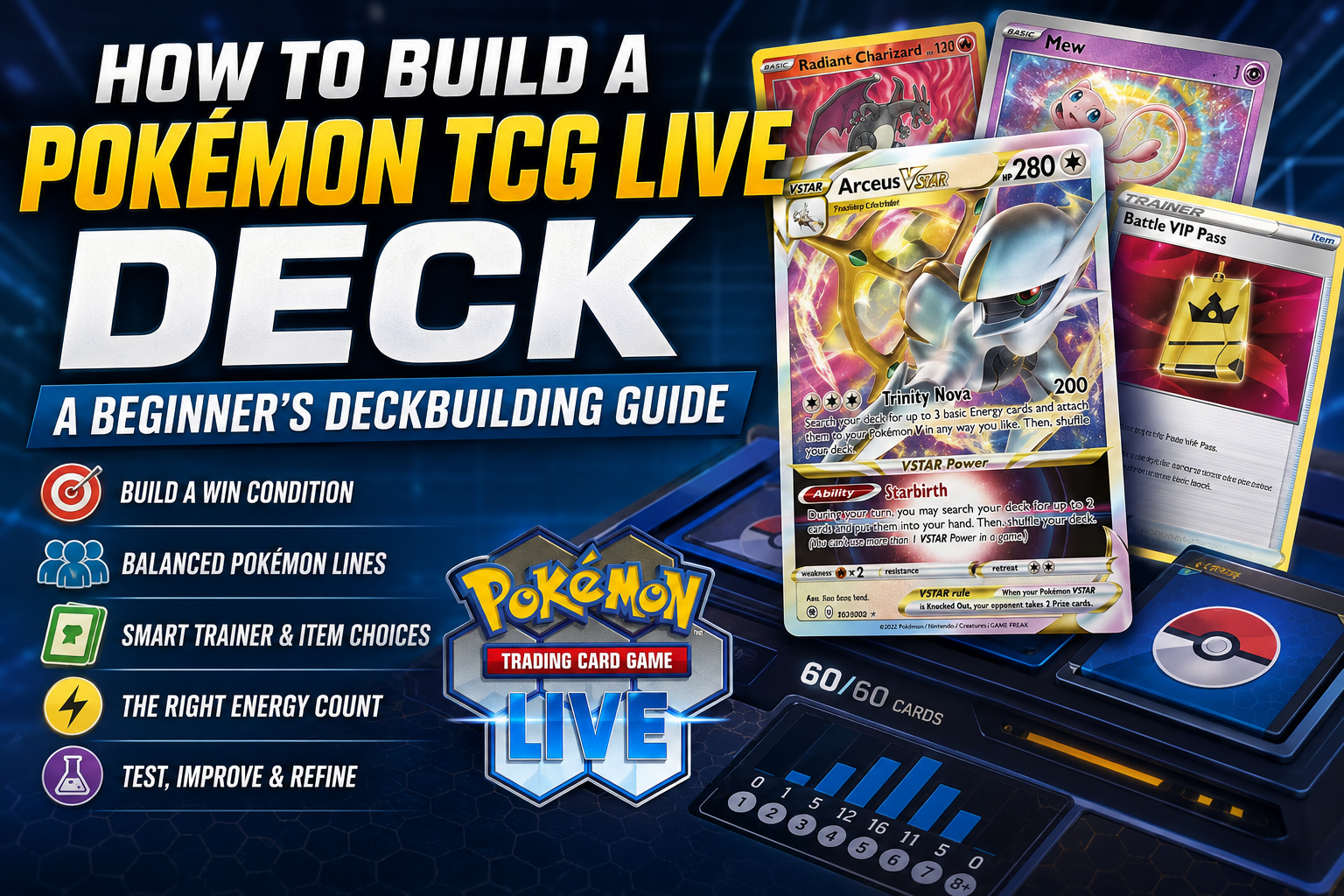
How to Build a Pokémon TCG Live Deck: A Beginner’s Deckbuilding Guide
Building your first Pokémon TCG Live deck can feel difficult at first. There are hundreds of Pokémon, Trainer cards, Energy types, evolution lines, Item cards, Supporters, Stadiums, Tools, and possible combinations. It is easy to open the Decks menu, add several cards you like, and end up with a list that looks fun but struggles to set up consistently. A good deck is not simply a group of strong cards. A good deck has a clear plan. It knows what it wants to do during the first turns, how it wants to take Prize cards, which Pokémon should attack, how it finds important cards, and how it recovers when the opponent disrupts its setup. This guide explains how to build a functional Pokémon TCG Live deck from scratch. It is designed for beginners, but the same process also applies when you are improving an existing list or building a new version of a popular archetype.
Start With the Rules Before Choosing Cards
Before you choose your main attacker, make sure you understand the basic construction rules. A Pokémon Trading Card Game deck must contain exactly 60 cards. It must include at least one Basic Pokémon. You can normally play no more than four cards with the same name, while Basic Energy is the major exception to that copy limit. Pokémon TCG Live helps with this process through its Deck Editor. The client can show deck-validation information and flag problems with the current list, which is especially useful when you are building for Standard format. Do not treat deck validation as the only test of whether a deck is good. A legal deck can still be inconsistent, slow, unfocused, or poorly prepared for the format. Validation confirms whether the list is allowed. Deckbuilding determines whether it can actually perform.
Choose One Main Win Condition
The first question to ask is simple: How does this deck win the game? Most successful decks have one central plan. That plan may involve taking fast Prize cards with a powerful Pokémon ex, setting up a Stage 2 attacker that can take repeated knockouts, spreading damage across the opponent’s board, denying Energy, disrupting the opponent’s hand, or trading efficiently with smaller Pokémon. Your main attacker should be the card that best represents that plan. For example, a deck could be built around a Pokémon that deals high damage with two Energy. Another deck could be built around a Pokémon whose Ability accelerates Energy. A different deck could focus on a Stage 2 Pokémon that takes time to set up but becomes extremely difficult to remove. Avoid starting with five or six different attackers that do unrelated things. A deck with too many ideas often fails because it draws the wrong half of its cards. You may have a strong attacker in hand but no Energy for it. You may have an evolution line but no Basic Pokémon. You may have a disruptive card but no way to create pressure. Start with one central attacker and one clear plan. Add secondary Pokémon only when they directly support that plan.
Build Your Pokémon Line Around Consistency
Once you know your main attacker, decide how reliably you need to find it. Basic Pokémon are naturally easier to use because they can be played directly from your hand. Stage 1 Pokémon require a Basic Pokémon first. Stage 2 Pokémon require even more setup unless you use evolution support such as Rare Candy. That does not mean Stage 2 decks are bad. It means they need more attention during deckbuilding. A Stage 2 deck often needs:
- Enough copies of the Basic Pokémon
- Enough copies of the Stage 2 Pokémon
- A reliable way to find both pieces
- Evolution support such as Rare Candy
- Trainer cards that help you draw through the deck
- A backup plan when the first evolution line is Knocked Out
A common beginner mistake is playing only one copy of a key Pokémon because it looks powerful. One copy may be fine for a niche support Pokémon. It is usually not enough for your main attacker. If your deck depends on a specific Pokémon to win, you need to give yourself multiple ways to find it. When building a Pokémon line, ask:
- Do I want this Pokémon in my opening hand?
- Do I need one copy or multiple copies in play?
- Can my opponent Knock Out my setup Pokémon before I evolve it?
- Does this Pokémon need a specific Energy type?
- Does it work as an attacker, a support card, or both?
Your Pokémon count should serve your strategy, not follow a fixed template. There is no universal ratio that works for every deck. A fast Basic-Pokémon deck may use fewer Pokémon and more Trainers. A Stage 2 deck may need more Pokémon and more evolution support. A control deck may have fewer attackers but more utility Pokémon.
Trainers Make Decks Consistent
New players often focus too heavily on Pokémon and Energy. In most competitive decks, Trainer cards are what make everything work. Trainer cards help you draw more cards, search for Pokémon, search for Items, recover resources, switch Pokémon, disrupt your opponent, remove Stadiums, move damaged targets, and create winning turns. A deck that contains powerful Pokémon but not enough Trainers will often fail to set up. Your Trainer cards should solve specific problems. Draw Supporters help when your hand is too small or missing key pieces. Professor’s Research is a common example of direct draw power. Other Supporters may shuffle your hand away and draw a new one based on the opponent’s hand size or another condition. Search cards help you find the Pokémon or Items your deck needs. These are especially important when your strategy relies on a particular Basic Pokémon, evolution card, or combo piece. Switching cards prevent bad opening positions from ruining the game. A powerful attacker is much less useful if it gets trapped Active before it is ready. Gust effects let you choose which opposing Pokémon must move into the Active Spot. These cards are important because they can turn damaged Bench Pokémon into Prize cards or force the opponent to expose a weak support Pokémon. Recovery cards help when a key Pokémon, Energy card, or Trainer reaches the discard pile too early. When deciding whether to include a Trainer card, ask what problem it solves. Do not include a card only because it is popular in another deck. A Trainer that is excellent in one archetype may be unnecessary in yours.
Decide Your Energy Count Last
Energy is essential, but beginners often add too much of it. Every Energy card you include is one less Pokémon or Trainer card. If your deck contains too much Energy, you may draw Energy when you need an attacker, search card, Supporter, or evolution piece. Instead of starting with an arbitrary number of Energy cards, start with your attacks. Ask:
- How much Energy does my main attacker require?
- Does the deck accelerate Energy?
- Does my attacker discard Energy after attacking?
- Do I need multiple Energy types?
- Can my Pokémon attack with Colorless costs?
- Does the deck need Energy recovery?
A deck with efficient two-Energy attackers may need fewer Energy cards than a deck that needs three or four Energy for its main attack. A deck with Energy acceleration may need a different count from a deck that attaches only once per turn. Multi-Energy decks require even more discipline. If your main attacker needs two specific Energy types, you need enough of both types to attack consistently. But you also need to avoid filling the deck with so much Energy that your setup becomes unreliable. This is one reason why multi-Energy decks are often harder to build than single-type decks.
Use the Pokémon TCG Live Deck Editor Properly
Pokémon TCG Live is especially useful for deckbuilding because it lets you build, edit, validate, and test your list in the same place. The Deck Editor includes filters that help you find cards, review variants, and identify missing pieces. Missing cards can be obtained through Trade Credits while creating a new deck or editing an existing deck. Pokémon Support notes that Trade Credit exchanges are final, so make sure you are crafting the correct card version before confirming. Do not spend Trade Credits on every interesting card immediately. Start by crafting cards that complete a full deck rather than random singles. A powerful Pokémon is not useful if you cannot build the rest of its engine around it. It is usually smarter to complete one consistent deck before spreading your Trade Credits across five unfinished ideas. The Deck Editor also makes it easier to test a list after making changes. Adjust one or two cards, play several games, and decide whether the change actually improved your consistency. Do not rebuild the entire deck after one unlucky match.
Test With a Question in Mind
Testing is not only about playing games. Testing is about learning why your deck wins and loses. After each match, ask:
- Did I find my Basic Pokémon quickly enough?
- Did I evolve on time?
- Did I have the correct Energy?
- Did I draw too many Energy cards?
- Did I have too few search cards?
- Did I lose because of my opponent’s strategy or because my own deck failed to function?
- Which card was stuck in my hand and never useful?
- Which card did I wish I had drawn more often?
This process helps you improve much faster than simply copying lists without understanding them. For example, if you regularly fail to find your Basic Pokémon, add more search or more copies of the Basic. If you evolve too slowly, review your Rare Candy count and draw engine. If you have enough attackers but never enough Energy, adjust your Energy count or add acceleration. If you constantly have Energy but no useful Trainer cards, reduce the Energy count. Small changes matter. Replacing two weak cards with two consistency cards can make a deck feel completely different.
Avoid These Common Deckbuilding Mistakes
The first mistake is playing too many one-of cards. A one-copy card is difficult to find unless your deck has strong search options. Use one-of cards for specific tech choices, not for your entire strategy. The second mistake is building around too many Pokémon. A deck should have a main attacker, support Pokémon, and possibly one or two backup attackers. It does not need every strong Pokémon of the same type. The third mistake is ignoring the first two turns. A deck can have an incredible late game and still lose because it cannot set up early. Always test opening hands and ask whether the deck can function when it does not draw perfectly. The fourth mistake is crafting before testing. Use the available cards in your collection first where possible. Learn whether you enjoy the strategy before committing a large amount of Trade Credits. The fifth mistake is changing too many cards at once. When a deck underperforms, change a small number of cards and test again. Otherwise, you will not know which change actually helped.
Final Deckbuilding Checklist
Before taking a new deck into ranked matches, check the following:
- Is the deck legal in the format I want to play?
- Do I have a clear main attacker and win condition?
- Do I have enough Basic Pokémon to set up consistently?
- Can I find my important evolution pieces?
- Do my Trainers solve specific problems?
- Do I have enough Energy, but not too much?
- Can I recover from a bad opening position?
- Can I deal with damaged Bench Pokémon or force targets Active?
- Have I tested the deck enough to identify weak cards?
- Am I crafting only the cards I actually need?
A strong Pokémon TCG Live deck is not built in one attempt. It is built through a process: choose a plan, build for consistency, test real games, identify problems, make small adjustments, and repeat. That process is what turns a pile of cards into a deck that can compete.
Got questions?
Drop into the Discord — most beginners get a deck-list reply within an hour.
Join the Discord