
Starmie Dusknoir
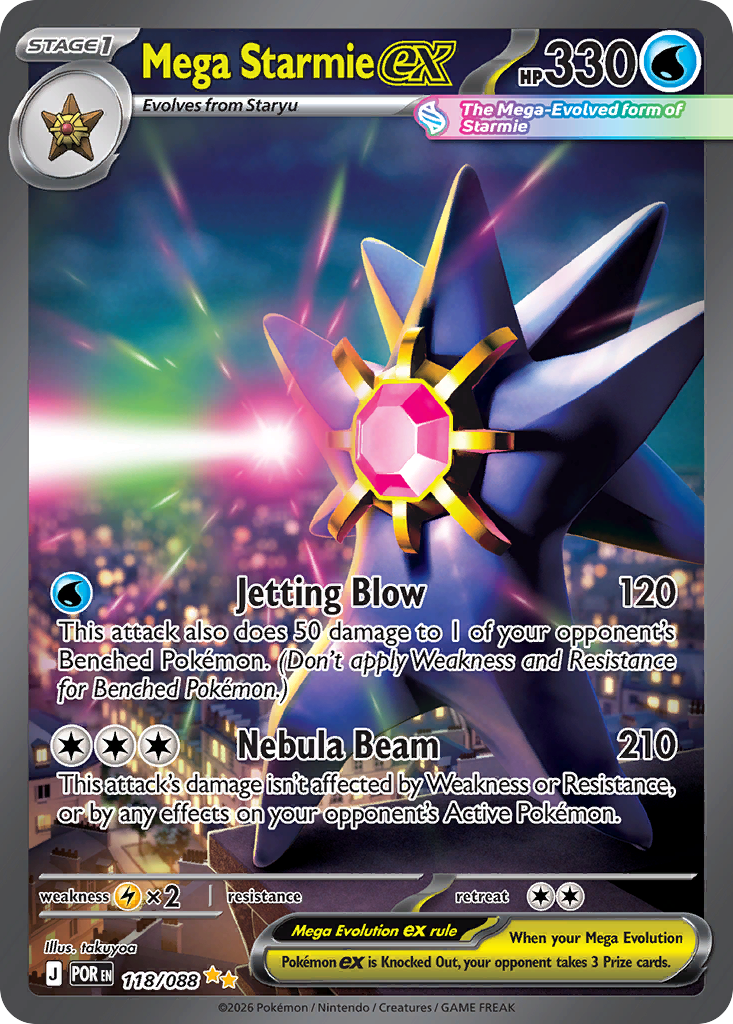
Mega Starmie Dusknoir is a Pokémon TCG Live Standard deck built around Staryu, Mega Starmie ex, Duskull, Dusclops, and Dusknoir. The deck combines fast Water-type pressure, damage manipulation, Risky Ruins chip damage, Munkidori utility, and late-game prize mapping with Bloodmoon Ursaluna ex.
Consensus Decklist
Pokémon (20)
Duskull
Dusclops
Dusknoir
Staryu
Mega Starmie ex
Budew
Meowth ex
Fezandipiti ex
Munkidori
Latias ex
Bloodmoon Ursaluna ex
Trainers (31)
Lillie's Determination
Hilda
Boss's Orders
Poké Pad
Buddy-Buddy Poffin
Ultra Ball
Risky Ruins
Night Stretcher
Pokégear 3.0
Special Red Card
Judge
Wally's Compassion
Energy
TCG Live Import List
Copy and paste into Pokémon TCG Live → Decks → Import.
Pokémon: 20
3 Duskull PRE 35
3 Dusclops PRE 36
2 Dusknoir PRE 37
3 Staryu POR 20
2 Mega Starmie ex POR 21
1 Budew ASC 16
1 Meowth ex POR 62
1 Fezandipiti ex ASC 142
2 Munkidori TWM 95
1 Latias ex SSP 76
1 Bloodmoon Ursaluna ex TWM 141

Trainer: 31
4 Lillie's Determination MEG 119
3 Hilda WHT 84
2 Boss's Orders MEG 114
3 Poké Pad POR 81
4 Buddy-Buddy Poffin TEF 144
4 Ultra Ball MEG 131
3 Risky Ruins MEG 127
2 Night Stretcher ASC 196
3 Pokégear 3.0 SVI 186
1 Special Red Card CRI 82
1 Judge POR 76
1 Wally's Compassion MEG 132

Energy: 9
3 Water Energy MEE 3
2 Ignition Energy WHT 86
1 Legacy Energy TWM 167
3 Darkness Energy MEE 7
Strategy Overview
Mega Starmie Dusknoir is a flexible Pokémon TCG Live Standard deck that blends aggressive pressure with tactical damage control. Instead of relying on one single attacker to carry the entire game, this list uses several different tools to create awkward board states for the opponent. Mega Starmie ex gives the deck a strong main attacker, while the Dusknoir line, Munkidori, Risky Ruins, Boss’s Orders, and late-game Bloodmoon Ursaluna ex allow the deck to turn chip damage into important Knock Outs. The Pokémon lineup is built around two main evolution packages. The first is the Starmie package: three Staryu and two Mega Starmie ex. This gives the deck a focused but not overcommitted attacker line. Mega Starmie ex is the card that applies direct offensive pressure, especially once the deck has established its Energy attachments and early support Pokémon. Because the line is relatively compact, the deck still has room for a strong Dusknoir package and several utility Pokémon. The second major package is Duskull, Dusclops, and Dusknoir. With a 3-3-2 line, this deck is more committed to Dusknoir than many lists that only use it as a tiny one-of package. That matters because Dusknoir is not just a bonus card here. It is part of the deck’s core game plan. The deck wants to create damage across the opponent’s board, then use Dusknoir pressure to finish targets, force awkward prize trades, or make Mega Starmie ex numbers much easier to reach. Munkidori is another important part of this damage-control plan. The list plays two copies, which signals that Munkidori is not just a random tech. It helps the deck manage damage placement and can make prize mapping much harder for the opponent. When combined with Dusknoir and Risky Ruins, Munkidori gives the deck several ways to convert small damage increments into meaningful turns. The Trainer engine is built for consistency and disruption. Lillie’s Determination, Hilda, Poké Pad, Pokégear 3.0, Buddy-Buddy Poffin, and Ultra Ball help the deck set up quickly and find the right pieces. Buddy-Buddy Poffin is especially important because the deck wants to open with multiple low-HP Basics: Staryu, Duskull, Budew, Munkidori, and sometimes Meowth ex depending on the hand. Ultra Ball then helps find Mega Starmie ex, Dusclops, Dusknoir, Fezandipiti ex, Latias ex, or Bloodmoon Ursaluna ex later in the game. The Energy lineup is also interesting. The deck plays Water Energy, Ignition Energy, Legacy Energy, and Darkness Energy. Water Energy supports Mega Starmie ex, Darkness Energy enables Munkidori, Ignition Energy can help accelerate or smooth certain attack turns, and Legacy Energy gives the deck a powerful special Energy option for prize-trade situations. Because the Energy base is mixed, sequencing matters a lot. You need to know early whether your next turns are focused on attacking with Mega Starmie ex, enabling Munkidori, or preparing a late-game attacker. Overall, Mega Starmie Dusknoir is a strategic deck. It does not only win by attacking every turn. It wins by setting up multiple threats, spreading or shifting damage, forcing the opponent to play around Dusknoir, and closing games with precise prize math.
Game Plan
The early game is about setup. Your first priority is getting Staryu and Duskull into play. Since the deck wants to develop both Mega Starmie ex and Dusknoir, a single Basic is usually not enough. Buddy-Buddy Poffin is your best early card because it can immediately establish multiple setup pieces. You should also think carefully about bench space. This deck wants Staryu, Duskull, Munkidori, Budew, Fezandipiti ex, Meowth ex, and sometimes Latias ex. That means the Bench can fill quickly. Do not bench every support Pokémon without a plan. Lillie’s Determination and Hilda are your key Supporters early. Lillie’s Determination helps refresh your hand, while Hilda can help find important evolution pieces. Ultra Ball is also important, but you need to discard carefully. The deck plays several one-of cards, including Budew, Meowth ex, Fezandipiti ex, Latias ex, Bloodmoon Ursaluna ex, Special Red Card, Judge, and Wally’s Compassion. Your early Energy attachments should match your planned attacker. If Mega Starmie ex is your first attacker, prioritize Water Energy or the correct special Energy setup. If Munkidori will matter in the matchup, make sure Darkness Energy is available.
The mid game is where the deck starts applying real pressure. By this point, you ideally have Mega Starmie ex attacking or ready to attack, while Dusclops or Dusknoir is developing on the Bench. Risky Ruins should also be considered whenever the Stadium pressure improves your damage math. This is where the deck becomes uncomfortable for the opponent. Mega Starmie ex threatens direct Knock Outs, while Dusknoir threatens indirect prize lines. Munkidori can help manipulate damage in a way that makes the opponent’s board harder to stabilize. Boss’s Orders is very important in this phase. Use it to target support Pokémon, damaged Pokémon, or evolution pieces before they become threats. Do not waste Boss’s Orders on a target that does not advance your prize plan. Special Red Card and Judge are also strongest in the mid game. Use them when the opponent has built a large hand or is preparing a key response turn. If you can combine hand disruption with a strong attack or Dusknoir play, you can often swing the game heavily in your favor.
The late game is about closing with exact prize math. By this stage, the opponent should have damage across the board, and your job is to identify the easiest remaining prizes. Dusknoir, Boss’s Orders, Munkidori, Risky Ruins, and Bloodmoon Ursaluna ex all matter here. Bloodmoon Ursaluna ex is one of the best late-game cards in the list. It allows the deck to close games without needing to fully rebuild another Mega Starmie ex. This is especially valuable if your main attacker was knocked out and your opponent thinks they have stabilized. Night Stretcher is also extremely important late. It can recover Dusknoir pieces, Mega Starmie ex, Munkidori, or a key support Pokémon. Do not spend both Night Stretcher too early unless it is necessary to keep your board alive. In the final turns, count everything. Count prizes, remaining Energy, available Boss’s Orders, Stadium damage, Dusknoir lines, and whether Bloodmoon Ursaluna ex can finish the game. This deck rewards players who plan two turns ahead.
Key Cards
- Duskull: Played in 100% of recent lists at an average of 3.1 copies.
- Dusclops: Played in 100% of recent lists at an average of 2.6 copies.
- Dusknoir: Played in 100% of recent lists at an average of 1.6 copies.
- Staryu: Played in 100% of recent lists at an average of 3.0 copies.
- Lillie's Determination: Trainer staple — 100% inclusion across the sample.
- Hilda: Trainer staple — 100% inclusion across the sample.
Strengths
- Strong combination of direct attacks and damage manipulation.
- Mega Starmie ex gives reliable offensive pressure.
- Dusknoir package creates strong late-game prize mapping.
- Munkidori adds flexible damage control.
- Risky Ruins helps create important chip damage.
- Buddy-Buddy Poffin gives strong early setup.
- Lillie’s Determination, Hilda, Poké Pad, and Pokégear 3.0 improve consistency.
- Bloodmoon Ursaluna ex gives a powerful late-game closer.
- Special Red Card and Judge provide disruption.
- Strong into decks that leave damaged Pokémon on the Bench.
Weaknesses
- Requires careful setup across multiple evolution lines.
- Bench space can become tight.
- Mixed Energy requirements can be awkward.
- Early Staryu or Duskull knockouts can slow the deck down.
- Dusknoir pieces can be prized or disrupted.
- The deck has many one-of cards, making Ultra Ball discards important.
- Aggressive decks can punish slow starts.
- Stadium removal can reduce Risky Ruins value.
- Poor sequencing can delay Mega Starmie ex attacks.
- The deck requires strong prize mapping to play optimally.
Matchups
- EvenAggressive Pokémon ex buildsTrade efficiently and prioritize knocking out two-prize attackers before they set up multi-prize swings.
- FavoredSetup / Stage 2 control decksApply early pressure before the opponent finds Rare Candy and Stage 2s.
- UnfavoredSingle-prize toolbox decksSave Boss/gust effects for the right turn; you cannot afford to take wrong knockouts.
Tips & Tricks
- Practice mulligan decisions ‑ a clean opening hand is worth more than perfect mid-game play.
- Track your opponent's energy attachments to predict next-turn threats.
- When in doubt, prioritize keeping Duskull active and powered.
Common Mistakes
- Attaching energy to the wrong attacker on turn 1.
- Using Boss/gust effects on the wrong target ‑ always count prizes first.
- Over-committing Pokémon to the bench, exposing yourself to spread damage.
Card Replacements
- Munkidori → Flexible slot — Included in 61% of lists ‑ swap based on expected matchups.
- Latias ex → Flexible slot — Included in 57% of lists ‑ swap based on expected matchups.
- Bloodmoon Ursaluna ex → Flexible slot — Included in 46% of lists ‑ swap based on expected matchups.
FAQ
Is Starmie Dusknoir good on Pokémon TCG Live ladder?
Yes ‑ this consensus list reflects 44 recent competitive decklists across 28 tournaments and is well-positioned in the current Standard format.
What format is this deck for?
Standard format Pokémon TCG (Live and paper).
Where does this list come from?
Generated from recent Limitless TCG Standard tournament results. Each card's inclusion rate is calculated from the actual decklists in our sample.