
Rocket's Mewtwo
Rocket’s Mewtwo is a Pokémon TCG Live Standard deck built around Team Rocket’s Mewtwo ex, Team Rocket’s Tarountula, Team Rocket’s Spidops, Team Rocket’s Articuno, and Team Rocket’s Mimikyu. The deck combines Team Rocket synergy, flexible attackers, Grass and Psychic Energy, disruption, recovery, and strong Supporter access through Team Rocket’s Transceiver.
Strategy Overview
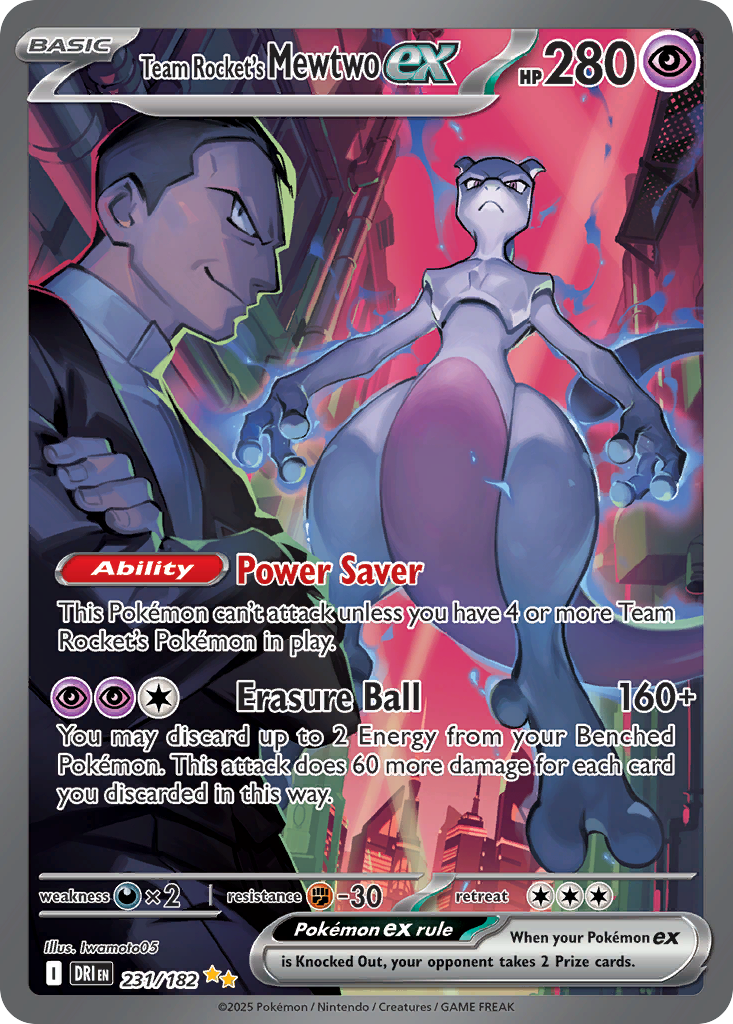
Rocket’s Mewtwo is a Team Rocket-focused Pokémon TCG Live deck that uses Team Rocket’s Mewtwo ex as its main offensive threat while supporting it with a full Team Rocket’s Tarountula and Team Rocket’s Spidops line. The deck also includes Team Rocket’s Articuno, Team Rocket’s Mimikyu, and Lillie’s Clefairy ex, giving it multiple ways to approach different matchups instead of relying on only one attacker. The core idea of the deck is to combine strong Team Rocket engine cards with flexible attacking options. Team Rocket’s Mewtwo ex gives the deck its main pressure point, while Spidops provides an additional evolution-based line that can support the game plan and force the opponent to respect multiple threats. Team Rocket’s Articuno and Team Rocket’s Mimikyu add extra utility, giving the deck more flexibility when the matchup does not line up perfectly for Mewtwo ex alone. One of the most important cards in the deck is Team Rocket’s Transceiver. With four copies, the list clearly wants reliable access to its Team Rocket Supporter package. Team Rocket’s Giovanni, Team Rocket’s Ariana, Team Rocket’s Proton, Team Rocket’s Petrel, and Team Rocket’s Archer all give the deck different options depending on the game state. This makes the deck more decision-heavy than a simple linear attacker deck. You need to know which Supporter matters on which turn, and you need to plan around your next few turns rather than only the current one. The Energy package is also important. The deck plays Grass Energy, Team Rocket’s Energy, and Psychic Energy. That means attachments need to be planned carefully. Team Rocket’s Mewtwo ex will usually be one of your main Energy targets, but the Grass line also matters because Team Rocket’s Tarountula and Team Rocket’s Spidops are central to the deck. Energy Switch gives the deck one extra way to reposition Energy when needed, but because it is only a single copy, you should not rely on it every game. This deck wants to set up efficiently, keep its Supporter engine flowing, and then pressure the opponent with the correct attacker for the matchup. It can play aggressively when Mewtwo ex is online early, but it can also take a more controlled approach by developing Spidops, using Team Rocket’s Supporters, and forcing the opponent into awkward prize trades. The biggest skill test is sequencing. You need to decide when to search for Pokémon, when to use Transceiver, when to commit Energy, when to recover with Night Stretcher, and when to save cards like Maximum Belt, Brave Bangle, Secret Box, or Team Rocket’s Petrel for a more important turn. Played well, Rocket’s Mewtwo can create constant pressure while still having enough disruption and flexibility to adapt.
Game Plan
In the early game, focus on building a stable board. Your ideal opening includes Team Rocket’s Tarountula, Team Rocket’s Mewtwo ex, and access to either Team Rocket’s Transceiver, Ultra Ball, Lillie’s Determination, Poké Pad, or Bug Catching Set. The deck wants to avoid slow starts because both Mewtwo ex and Spidops need some setup before they can fully pressure the opponent. Team Rocket’s Tarountula is very important early because it starts your Spidops line. If you only focus on Mewtwo ex, your board can become too narrow. Setting up Tarountula gives you another line of play and makes it harder for the opponent to disrupt you with one knockout. Be careful with Ultra Ball discards. This deck contains several important one-of cards, including Energy Switch, Team Rocket’s Petrel, Team Rocket’s Archer, Brave Bangle, Maximum Belt, and Secret Box. These cards can be very important in specific turns. Discarding them too early may remove your best late-game option. Your first Energy attachment should usually go toward the attacker that your hand can support most reliably. If you already have a Mewtwo ex plan, start building that. If your hand is more Grass-focused and you can develop Spidops quickly, it may be correct to support that line first. The key is to avoid random attachments that do not lead to a clear attack plan.
The mid game is where Rocket’s Mewtwo wants to take control. By this point, you should have Team Rocket’s Mewtwo ex applying pressure or close to attacking, while Team Rocket’s Spidops is either in play or ready to evolve. This is also where your Team Rocket Supporter toolbox becomes extremely important. Team Rocket’s Giovanni, Ariana, Proton, Petrel, and Archer all give you different options. Some games will require more setup. Others will require disruption. Some will need direct pressure. The strength of this deck is that Team Rocket’s Transceiver helps you find the Supporter that fits the current board state. This is also the phase where you need to manage your prize plan. Decide which Pokémon will take your first major knockout and which Pokémon will follow up. If the opponent is targeting your Mewtwo ex, you should be developing Spidops or another attacker behind it. If the opponent is ignoring Spidops, you may be able to use that line to build a better board state. Cards like Maximum Belt and Brave Bangle should not be rushed. Their best use is when they turn a close damage number into a real knockout. If the extra damage does not change the prize trade, it may be better to save the tool for a more important turn.
The late game is about closing the prize race cleanly. Count your remaining Energy, check your discard pile, and know which attackers are still available. Because the deck uses multiple Energy types, you need to be very aware of what is left in the deck and what is already committed to the board. Night Stretcher becomes especially important late. If Team Rocket’s Mewtwo ex, Spidops, Articuno, or Mimikyu have been knocked out or discarded, Night Stretcher can help you rebuild enough pressure to finish the game. Do not waste recovery too early unless you need it to keep attacking. Team Rocket’s Petrel, Team Rocket’s Archer, Special Red Card-style disruption, or similar late-game disruption tools can be strongest when the opponent is trying to assemble their final knockout. If you can disrupt their hand or board while presenting a strong attacker, you can force them into an awkward final turn. The final turns often come down to prize mapping. You need to know whether your last prizes come from a large attacker, a support Pokémon, or a damaged Bench target. Avoid benching unnecessary liabilities late, especially Pokémon that give the opponent an easy prize route. Every Bench slot should have a purpose.
Key Cards
- Team Rocket's Tarountula: Played in 100% of recent lists at an average of 4.0 copies.
- Team Rocket's Spidops: Played in 100% of recent lists at an average of 3.9 copies.
- Team Rocket's Mewtwo ex: Played in 100% of recent lists at an average of 2.0 copies.
- Team Rocket's Articuno: Played in 100% of recent lists at an average of 1.8 copies.
- Team Rocket's Giovanni: Trainer staple — 100% inclusion across the sample.
- Team Rocket's Ariana: Trainer staple — 100% inclusion across the sample.
Strengths
- Strong Team Rocket synergy across Pokémon, Supporters, Energy, and Stadium.
- Team Rocket’s Mewtwo ex gives the deck a powerful main attacker.
- Full Team Rocket’s Tarountula and Spidops line adds a second core threat.
- Team Rocket’s Transceiver provides strong access to the Supporter toolbox.
- Multiple Team Rocket Supporters give the deck flexible answers.
- Team Rocket’s Articuno and Team Rocket’s Mimikyu add matchup flexibility.
- Night Stretcher provides recovery after knockouts or early discards.
- Maximum Belt and Brave Bangle can create important knockout turns.
- Secret Box gives the deck a powerful one-card utility option.
- The deck rewards strong sequencing and careful resource planning.
Weaknesses
- Multiple Energy types make attachment decisions more punishing.
- The deck can stumble if it misses early Tarountula or Mewtwo ex setup.
- Spidops requires evolution, so early pressure can slow the board down.
- Several important cards are single-copy techs and can be awkward if prized or discarded.
- The deck relies heavily on sequencing the correct Supporter at the correct time.
- Stadium removal can reduce the value of Team Rocket’s Factory.
- Aggressive decks can punish slow starts.
- Energy Switch is only a one-of, so it cannot be treated as a guaranteed fix.
- Bench management matters because support Pokémon can become easy targets.
- The deck may struggle if the first main attacker is removed before a backup is ready.
Matchups
- EvenAggressive Pokémon ex buildsTrade efficiently and prioritize knocking out two-prize attackers before they set up multi-prize swings.
- FavoredSetup / Stage 2 control decksApply early pressure before the opponent finds Rare Candy and Stage 2s.
- UnfavoredSingle-prize toolbox decksSave Boss/gust effects for the right turn; you cannot afford to take wrong knockouts.
Consensus Decklist
Pokémon (17)
Team Rocket's Tarountula
Team Rocket's Spidops
Team Rocket's Mewtwo ex
Team Rocket's Articuno
Team Rocket's Mimikyu
Lillie's Clefairy ex
Trainers (33)
Team Rocket's Giovanni
Team Rocket's Ariana
Team Rocket's Proton
Team Rocket's Transceiver
Night Stretcher
Team Rocket's Factory
Ultra Ball
Energy Switch
Team Rocket's Petrel
Team Rocket's Archer
Lillie's Determination
Brave Bangle
Poké Pad
Bug Catching Set
Maximum Belt
Secret Box
Energy
TCG Live Import List
Copy and paste into Pokémon TCG Live → Decks → Import.
Pokémon: 17
4 Team Rocket's Tarountula DRI 19
4 Team Rocket's Spidops DRI 20
4 Team Rocket's Mewtwo ex DRI 81
2 Team Rocket's Articuno DRI 51
2 Team Rocket's Mimikyu DRI 87
1 Lillie's Clefairy ex JTG 56

Trainer: 33
3 Team Rocket's Giovanni DRI 174
3 Team Rocket's Ariana DRI 171
3 Team Rocket's Proton DRI 177
4 Team Rocket's Transceiver DRI 178
2 Night Stretcher ASC 196
2 Team Rocket's Factory DRI 173
3 Ultra Ball MEG 131
1 Energy Switch MEG 115
1 Team Rocket's Petrel DRI 176
1 Team Rocket's Archer DRI 170
3 Lillie's Determination MEG 119
1 Brave Bangle WHT 80
2 Poké Pad POR 81
2 Bug Catching Set TWM 143
1 Maximum Belt TEF 154
1 Secret Box TWM 163

Energy: 10
4 Grass Energy MEE 1
4 Team Rocket's Energy DRI 182
2 Psychic Energy MEE 5
Tips & Tricks
- Practice mulligan decisions ‑ a clean opening hand is worth more than perfect mid-game play.
- Track your opponent's energy attachments to predict next-turn threats.
- When in doubt, prioritize keeping Team Rocket's Tarountula active and powered.
Common Mistakes
- Attaching energy to the wrong attacker on turn 1.
- Using Boss/gust effects on the wrong target ‑ always count prizes first.
- Over-committing Pokémon to the bench, exposing yourself to spread damage.
Card Replacements
- Poké Pad → Flexible slot — Included in 60% of lists ‑ swap based on expected matchups.
- Bug Catching Set → Flexible slot — Included in 52% of lists ‑ swap based on expected matchups.
- Maximum Belt → Flexible slot — Included in 45% of lists ‑ swap based on expected matchups.
FAQ
Is Rocket's Mewtwo good on Pokémon TCG Live ladder?
Yes ‑ this consensus list reflects 65 recent competitive decklists across 30 tournaments and is well-positioned in the current Standard format.
What format is this deck for?
Standard format Pokémon TCG (Live and paper).
Where does this list come from?
Generated from recent Limitless TCG Standard tournament results. Each card's inclusion rate is calculated from the actual decklists in our sample.