
N's Zoroark
N’s Zoroark is a Pokémon TCG Live Standard deck built around N’s Zorua, N’s Zoroark ex, N’s Zekrom, and a flexible Darkness-based support package. The deck uses Buddy-Buddy Poffin, Lillie’s Determination, Boss’s Orders, N’s PP Up, N’s Castle, Night Stretcher, and Binding Mochi to set up quickly, apply pressure, and control prize trades with a low Energy count.
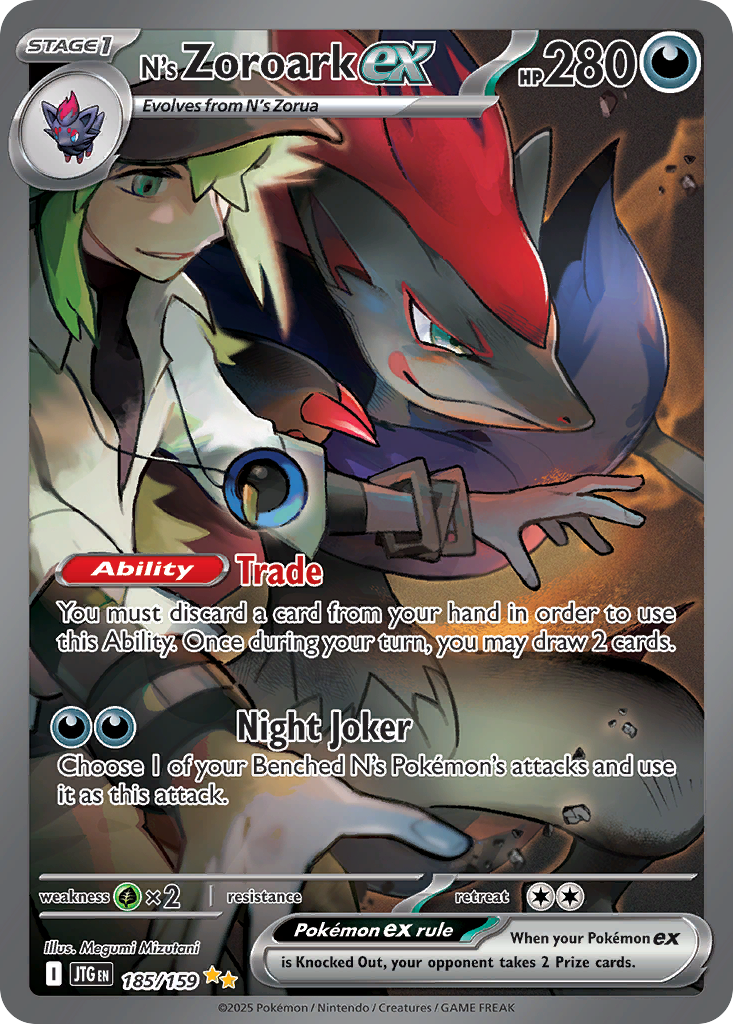
Consensus Decklist
Pokémon (22)
N's Zorua
N's Zoroark ex
N's Zekrom
Munkidori
Pecharunt ex
N's Reshiram
Fezandipiti ex
Yveltal
N's Darumaka
N's Darmanitan
Meowth ex
Budew
Trainers (34)
Lillie's Determination
Boss's Orders
Buddy-Buddy Poffin
Night Stretcher
N's PP Up
Poké Pad
N's Castle
Cyrano
Ultra Ball
Black Belt's Training
Special Red Card
Binding Mochi
Team Rocket's Watchtower
Janine's Secret Art
Energy
TCG Live Import List
Copy and paste into Pokémon TCG Live → Decks → Import.
Pokémon: 22
4 N's Zorua JTG 97
4 N's Zoroark ex JTG 98
4 N's Zekrom ASC 155
2 Munkidori TWM 95
1 Pecharunt ex SFA 39
1 N's Reshiram JTG 116
1 Fezandipiti ex ASC 142
1 Yveltal MEG 88
1 N's Darumaka JTG 26
1 N's Darmanitan JTG 27
1 Meowth ex POR 62
1 Budew ASC 16

Trainer: 34
4 Lillie's Determination MEG 119
4 Boss's Orders MEG 114
4 Buddy-Buddy Poffin TEF 144
3 Night Stretcher ASC 196
3 N's PP Up JTG 153
3 Poké Pad POR 81
2 N's Castle JTG 152
2 Cyrano SSP 170
3 Ultra Ball MEG 131
1 Black Belt's Training JTG 143
1 Special Red Card CRI 82
2 Binding Mochi PRE 95
1 Team Rocket's Watchtower DRI 180
1 Janine's Secret Art PRE 112

Energy: 4
4 Darkness Energy MEE 7
Strategy Overview
N’s Zoroark is a Darkness-focused Pokémon TCG Live deck built around the N’s Zorua and N’s Zoroark ex evolution line. The list plays a full four copies of N’s Zorua and four copies of N’s Zoroark ex, which makes the deck very clearly centered around setting up Zoroark ex as consistently as possible. Unlike slower evolution decks that rely on multiple Stage 2 attackers, N’s Zoroark ex is a Stage 1-focused strategy that wants to establish pressure quickly while using a wide toolbox of support Pokémon to handle different board states. The most interesting part of this deck is how lean the Energy package is. The list plays only four Darkness Energy, which means every attachment matters. You cannot afford to waste Energy, attach without a clear plan, or discard Energy recklessly. Because the Energy count is so low, cards like N’s PP Up, Night Stretcher, N’s Castle, and careful sequencing become extremely important. The deck is built to operate efficiently, but that efficiency comes with a cost: bad Energy management can lose games quickly. N’s Zekrom is one of the most important secondary Pokémon in the deck. With four copies, it is not just a small tech card. It gives the deck another N’s Pokémon that supports the overall strategy and helps increase consistency around the N’s engine. N’s Reshiram, N’s Darumaka, and N’s Darmanitan give the list additional N-themed flexibility, while Yveltal and Pecharunt ex give the deck extra utility outside the main Zoroark plan. The Trainer engine is built for consistency and pressure. Buddy-Buddy Poffin helps establish N’s Zorua and other small Basics early. Ultra Ball finds important Pokémon, while Lillie’s Determination gives the deck strong draw power. Poké Pad helps reach Supporters more often, especially Boss’s Orders, which is one of the most important cards in the list. Four Boss’s Orders means the deck wants to control the prize map aggressively and punish opponents who leave vulnerable Pokémon on the Bench. Binding Mochi, Pecharunt ex, Munkidori, and Janine’s Secret Art add another layer of utility and damage manipulation. These cards give the deck more tactical flexibility than a simple Stage 1 attacker deck. Instead of only attacking whatever is Active, N’s Zoroark wants to manage board states, set up key knockouts, and force the opponent into awkward prize trades. This deck rewards players who plan ahead. Your turns should not be random. You need to know which Pokémon you are developing, where each Darkness Energy should go, when to recover attackers with Night Stretcher, when to use Boss’s Orders, and when to hold disruptive cards like Special Red Card or Team Rocket’s Watchtower. When sequenced well, N’s Zoroark can apply fast pressure while still having enough flexibility to adapt to many matchups.
Game Plan
In the early game, your first priority is board setup. The ideal start includes N’s Zorua, Buddy-Buddy Poffin, and access to draw or search cards. You usually want at least two N’s Zorua in play if possible, because relying on only one can be risky against aggressive opponents. Buddy-Buddy Poffin is one of the best early cards in the deck because it helps fill your Bench with the small Basics you need. N’s Zorua should usually be the priority, but depending on your hand, Budew, N’s Darumaka, or other small Pokémon can also matter. Ultra Ball should be used carefully. This deck has several important low-copy cards, including Pecharunt ex, N’s Reshiram, Yveltal, N’s Darumaka, N’s Darmanitan, Meowth ex, Budew, Black Belt’s Training, Special Red Card, Team Rocket’s Watchtower, and Janine’s Secret Art. Discarding one of these cards too early can remove an important option from the game. Your first Darkness Energy attachment matters a lot. With only four Energy total, do not attach randomly. If your hand supports an early Zoroark ex, attach toward that line. If your hand is awkward, it may be better to wait until you know which attacker will actually become active.
The mid game is where N’s Zoroark wants to take control. By this point, your first N’s Zoroark ex should be ready or close to attacking. Your goal is to pressure the opponent while setting up your next attacker. The deck cannot afford to take a turn off, so always think about the follow-up before your first attacker is knocked out. Boss’s Orders is especially strong in the mid game. Use it to target support Pokémon, evolving Pokémon, damaged attackers, or anything the opponent is trying to protect. Since this deck plays four Boss’s Orders, it can repeatedly pressure the Bench and force the opponent to respond. Night Stretcher becomes useful once the first exchanges begin. If N’s Zorua or N’s Zoroark ex is knocked out or discarded early, Night Stretcher helps rebuild the board. Do not waste Night Stretcher too early if you do not need it. Its value increases when the discard pile contains important Pokémon you need for the next turn. Binding Mochi and Pecharunt ex can create important damage math situations. These cards should be used when they help secure a knockout or force a better prize trade. Do not use damage-boosting or utility tools just because they are available. Use them when they change the outcome of a turn.
The late game is about prize mapping and resource management. Count your remaining Darkness Energy, check your discard pile, and know which attackers are still available. Because the deck plays only four Energy, the final turns can become difficult if you have attached poorly or lost too many resources earlier. Boss’s Orders is often your best closing card. A late Boss’s Orders can target a damaged Pokémon, a support Pokémon, or a low-HP Bench target to finish the game. Try to preserve at least one gust effect for the final prize turn if possible. Night Stretcher can also decide late games. If your opponent removes your main attacker, Night Stretcher can help rebuild one more Zoroark ex line or recover another key Pokémon. In close games, one recovered attacker can be the difference between winning and missing the final attack. Be careful with Bench liabilities late. Fezandipiti ex, Meowth ex, Pecharunt ex, or other support Pokémon can be useful earlier, but they may become easy prize targets later. Only bench additional Pokémon late if they directly help you win or prevent you from losing tempo. Special Red Card and Team Rocket’s Watchtower can be valuable late-game disruption tools. If the opponent is holding a large hand or preparing a final combo turn, disruption can force them to miss the pieces they need.
Key Cards
- N's Zorua: Played in 100% of recent lists at an average of 4.0 copies.
- N's Zoroark ex: Played in 100% of recent lists at an average of 4.0 copies.
- N's Zekrom: Played in 100% of recent lists at an average of 1.7 copies.
- Munkidori: Played in 96% of recent lists at an average of 1.5 copies.
- Lillie's Determination: Trainer staple — 100% inclusion across the sample.
- Boss's Orders: Trainer staple — 100% inclusion across the sample.
Strengths
- Fast Stage 1-focused game plan with N’s Zoroark ex.
- Full 4-4 N’s Zorua and N’s Zoroark ex line improves consistency.
- N’s Zekrom provides strong N’s engine support.
- Four Boss’s Orders give excellent prize-map control.
- Buddy-Buddy Poffin helps establish multiple Basics early.
- Lillie’s Determination and Poké Pad improve draw and Supporter access.
- Night Stretcher gives strong recovery after knockouts or discards.
- Binding Mochi and Pecharunt ex provide flexible damage and utility options.
- Toolbox Pokémon give the deck multiple matchup-specific lines.
- Low Energy count makes the deck efficient when sequenced correctly.
Weaknesses
- Only four Darkness Energy makes missed attachments very punishing.
- The deck can struggle if early N’s Zorua are removed before evolving.
- Low-copy tech cards can be awkward if prized or discarded.
- The deck requires careful sequencing and resource planning.
- Heavy disruption can slow down the setup.
- Energy denial can be difficult because the deck has very little Energy.
- Bench liabilities can be punished by Boss’s Orders.
- Overusing Ultra Ball can remove important late-game options.
- The deck can lose tempo if the first Zoroark ex is knocked out without a backup ready.
- Newer players may struggle to identify the correct toolbox line.
Matchups
- EvenAggressive Pokémon ex buildsTrade efficiently and prioritize knocking out two-prize attackers before they set up multi-prize swings.
- FavoredSetup / Stage 2 control decksApply early pressure before the opponent finds Rare Candy and Stage 2s.
- UnfavoredSingle-prize toolbox decksSave Boss/gust effects for the right turn; you cannot afford to take wrong knockouts.
Tips & Tricks
- Practice mulligan decisions ‑ a clean opening hand is worth more than perfect mid-game play.
- Track your opponent's energy attachments to predict next-turn threats.
- When in doubt, prioritize keeping N's Zorua active and powered.
Common Mistakes
- Attaching energy to the wrong attacker on turn 1.
- Using Boss/gust effects on the wrong target ‑ always count prizes first.
- Over-committing Pokémon to the bench, exposing yourself to spread damage.
Card Replacements
- N's Darumaka → Flexible slot — Included in 61% of lists ‑ swap based on expected matchups.
- N's Darmanitan → Flexible slot — Included in 61% of lists ‑ swap based on expected matchups.
- Meowth ex → Flexible slot — Included in 48% of lists ‑ swap based on expected matchups.
FAQ
Is N's Zoroark good on Pokémon TCG Live ladder?
Yes ‑ this consensus list reflects 163 recent competitive decklists across 37 tournaments and is well-positioned in the current Standard format.
What format is this deck for?
Standard format Pokémon TCG (Live and paper).
Where does this list come from?
Generated from recent Limitless TCG Standard tournament results. Each card's inclusion rate is calculated from the actual decklists in our sample.